

Bacterial Transformation
Bacterial Transformation The Complete Science Guide
Definition
What Is Bacterial Transformation?
Bacterial transformation is the uptake and stable incorporation of exogenous (foreign) DNA, most commonly a plasmid, by a bacterial cell from its surrounding environment. The cell gains new genetic traits such as antibiotic resistance or the ability to produce a target protein.

First described by Frederick Griffith in 1928 and confirmed by Avery, MacLeod, and McCarty in 1944, bacterial transformation proved that DNA, not protein, is the molecule of heredity. Today it is a cornerstone technique in every molecular biology laboratory. Pubmed Reference
Mechanism
How Does Bacterial Transformation Work?
The process requires bacteria to be in a competent state, a physiological condition where cells can take up DNA. Competence can arise naturally (as in Streptococcus pneumoniae) or be artificially induced in the lab.
Bacteria (usually E. coli) are suspended in ice-cold CaCl₂. Calcium ions destabilize the membrane, priming it for DNA uptake.

The target plasmid, carrying your gene of interest and an antibiotic-resistance marker, is mixed gently with the competent cells and incubated on ice for 20-30 min.

A 30-90 second thermal shift opens transient pores in the membrane. Immediate return to ice reseals the membrane, trapping the plasmid inside.

Cells recover in warm LB broth for ~1 hour, then are plated on antibiotic agar. Only successfully transformed colonies survive and grow.

Key Mechanism
What Is the Purpose of Heat Shock?
When cells suspended in CaCl₂ shift rapidly from 0 °C to 42 °C, three things happen:
- Rapid thermal flux creates transient pores in the lipid bilayer.
- The DNA-calcium complex is driven in via concentration and electrochemical gradients.
- Rapid return to ice causes the membrane to reseal, trapping DNA inside.
"Heat shock is deceptively simple, a 42-second step that has enabled decades of molecular cloning and the entire recombinant protein industry."
* Molecular Biology of the Cell, Alberts et al.Electroporation is the high-efficiency alternative: a brief electric pulse achieves the same membrane disruption with up to 10× more colonies, preferred for difficult-to-transform strains.
Electroporation Vs. Heat Shock?

Related Concept
What Is a Plasmid?
A plasmid is a small, circular, double-stranded DNA molecule that replicates independently of the bacterial chromosome. In transformation, engineered plasmids act as vectors, delivering a gene of interest plus a selection marker into the host cell.
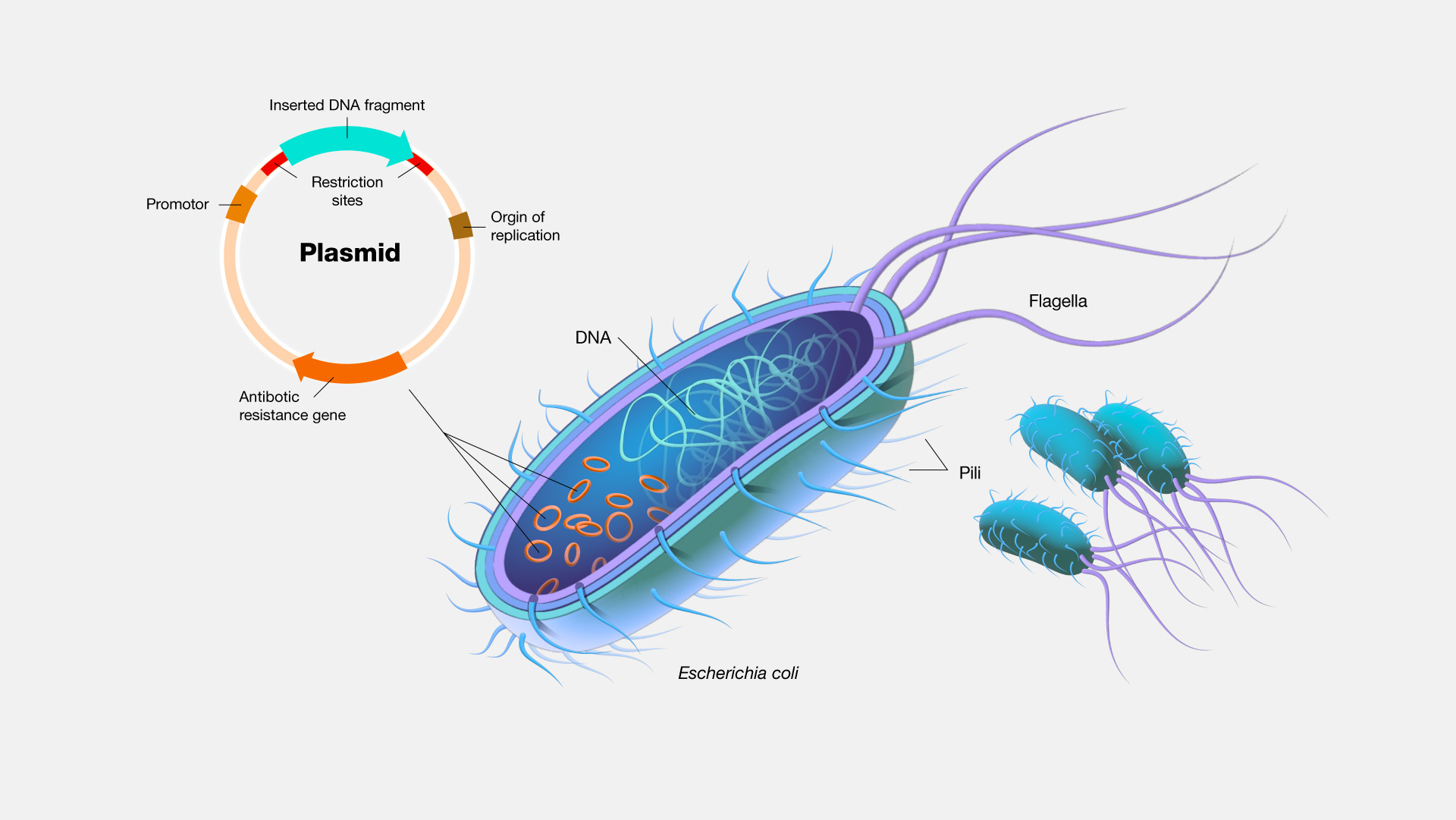
| Feature | Bacterial Chromosome | Plasmid |
|---|---|---|
| Shape | Circular (most bacteria) | Circular (small) |
| Size | ~4.6 Mb (E. coli) | 1 - 200 kb |
| Replication | Once per cell cycle | Independent; multiple copies |
| Essential? | Yes, core cell functions | No, accessory genes only |
| Transfer | Binary fission | Transformation, conjugation, transduction |
Why It Matters?
Why Is Bacterial Transformation Important?
Bacterial transformation is the engine behind the entire recombinant DNA industry, spanning medicine, agriculture, and fundamental research.
Human insulin, growth hormone, and monoclonal antibodies are produced at industrial scale in transformed bacteria and yeast.
Researchers amplify specific DNA sequences by inserting them into a plasmid and generating millions of identical transformed bacterial copies.
Recombinant antigens like hepatitis B surface antigen are expressed in transformed bacteria for safe, scalable vaccine production.
Transformation delivers Cas9-guide RNA plasmids into bacteria and plant cells for precise single-nucleotide genome editing.
Ready to Run Your Own Transformation?
Get lab-tested competent cells, plasmids, and reagents shipped fast, everything you need for a clean, high-efficiency transformation protocol.
Shop Transformation Kits →