

Agrobacterium Mediated Gene Transfer
Agrobacterium Mediated Gene Transfer : Mechanism, Steps, Diagram and Applications in Plants
A clear scientific guide to Agrobacterium tumefaciens mediated gene transfer, including T-DNA transfer, Vir genes, Ti plasmid function, plant transformation workflow and biotechnology applications.
What Is Agrobacterium Mediated Gene Transfer?
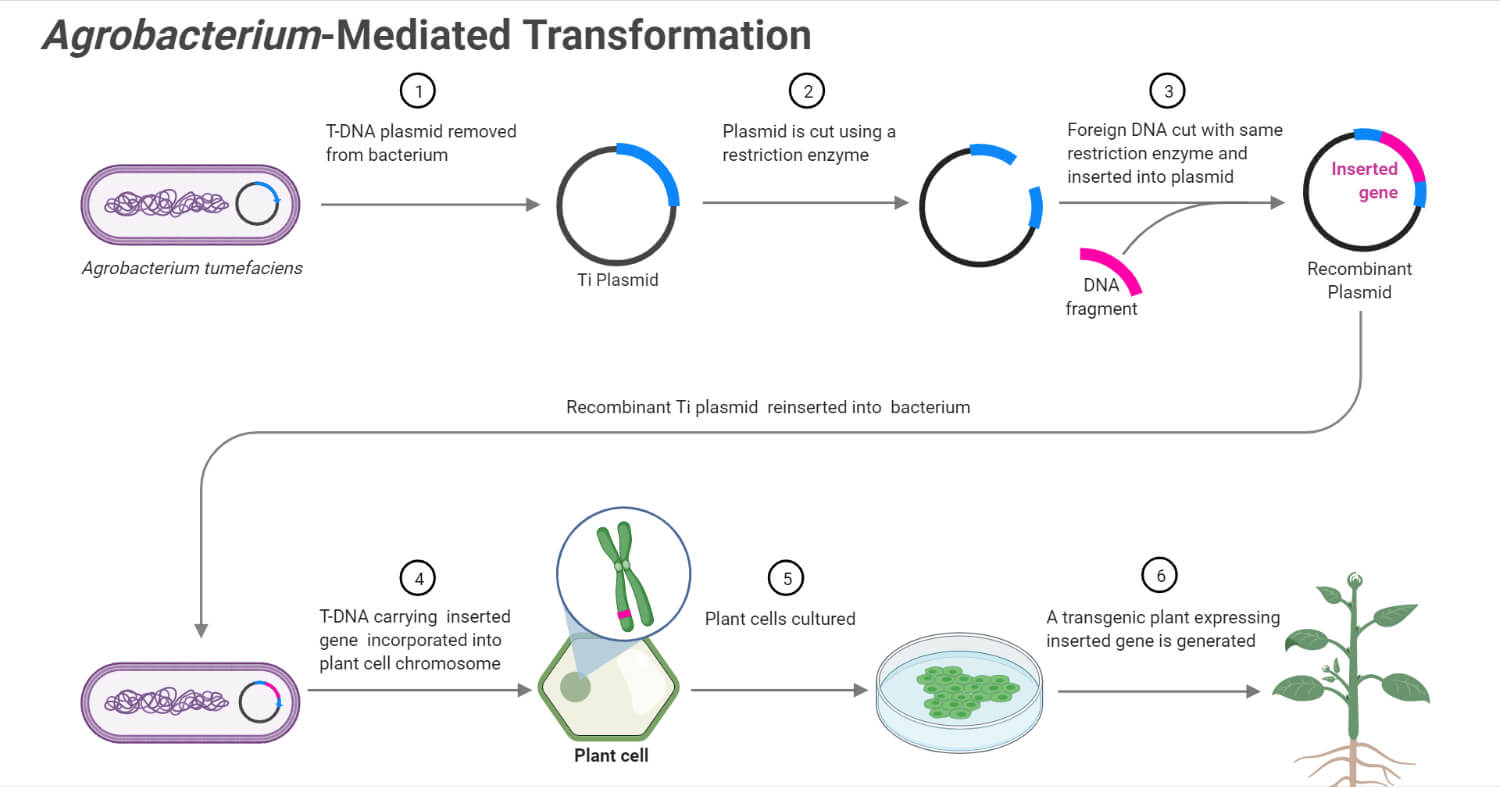
Agrobacterium mediated gene transfer is a natural DNA transfer process used by Agrobacterium tumefaciens to introduce a specific DNA segment, known as T-DNA, into plant cells.
In modern plant biotechnology, scientists use this natural mechanism as a controlled genetic transformation system. The tumor-inducing genes of the bacterial Ti plasmid are removed and replaced with a selected gene of interest. This allows researchers to study gene function, create transgenic plants, support crop improvement programs and deliver molecular tools into plant tissues.
Why Agrobacterium tumefaciens Is Important?
Agrobacterium tumefaciens is important because it naturally transfers DNA into plant cells. This ability depends mainly on the Ti plasmid, which contains the T-DNA region and virulence genes required for DNA transfer.

In laboratory transformation systems, the natural disease-causing region is removed. The bacterium is then engineered to carry a useful DNA sequence, such as a reporter gene, selectable marker, promoter sequence, resistance gene or gene-editing component.
Molecular Mechanism of T-DNA Transfer
The mechanism of Agrobacterium mediated gene transfer involves several coordinated biological steps. These steps begin when a wounded plant tissue releases chemical signals that activate the bacterium.
Plant Wound Signal Recognition
Wounded plant cells release phenolic compounds and sugars that attract Agrobacterium.
Activation of Vir Genes
Virulence genes are activated and prepare the bacterial transfer machinery.
T-DNA Processing
The T-DNA region is cut from the Ti plasmid and prepared as a transferable DNA strand.
Transfer into Plant Cell
The T-DNA complex is transferred through a bacterial secretion system into the plant cell.
Nuclear Import and Integration
The T-DNA enters the plant nucleus and may integrate into plant genomic DNA.

Agrobacterium Mediated Gene Transfer Diagram Explanation
A scientific diagram of Agrobacterium mediated gene transfer should show the complete path of T-DNA from the bacterium to the plant genome. This helps students, researchers and biotechnology readers understand the transformation workflow visually.
Plant signals are released.
Vir genes are activated.
T-strand is generated.
T-DNA reaches genomic DNA.
Role of Ti Plasmid, T-DNA and Vir Genes
| Component | Scientific Role |
|---|---|
|
Ti plasmid |
Large bacterial plasmid carrying the T-DNA region and virulence gene system. |
| T-DNA | DNA segment transferred from Agrobacterium into the plant cell. |
| Vir genes | Genes that control T-DNA processing, transfer and nuclear targeting. |
| Gene of interest |
Selected DNA sequence inserted into the vector for plant transformation. |

Applications in Plant Biotechnology
Plant Gene Function
Used to study gene expression, promoter activity and plant molecular pathways.
Crop Trait Research
Supports research into traits such as stress tolerance, plant development and resistance mechanisms.
Transgenic Plant Production
Used to generate stable transformed plant lines for research and biotechnology.
Genome Editing Delivery
Can deliver gene-editing constructs into plant tissues in transformation workflows.
Advantages and Limitations
| Advantages | Limitations |
|---|---|
| Stable gene integration in many plant systems. | Transformation efficiency depends on plant species and genotype. |
| Often produces lower copy number insertions compared with some physical methods. | Requires optimized tissue culture and regeneration conditions. |
| Highly useful for dicots and many optimized monocot protocols. | Some plant tissues are difficult to transform. |
| Compatible with many plant biotechnology workflows. | Protocol optimization may be time-consuming. |
Agrobacterium Mediated Gene Transfer in Plants
Agrobacterium mediated gene transfer in plants is commonly performed using explants such as leaf discs, cotyledons, embryos, callus tissue or meristematic tissues. The plant material is exposed to engineered Agrobacterium, followed by co-cultivation, selection and regeneration.
The final result may be a transformed plant tissue, callus, shoot, root or complete regenerated plant, depending on the experimental design and the regeneration capacity of the selected plant species.
Frequently Asked Questions
What is Agrobacterium mediated gene transfer?
It is a plant transformation method using Agrobacterium tumefaciens to transfer T-DNA into plant cells.
Which plasmid is used in Agrobacterium mediated transformation?
The Ti plasmid is used. In research, this plasmid is modified to carry a gene of interest.
What is the role of Vir genes?
Vir genes encode proteins that process, protect and transfer T-DNA from Agrobacterium into the plant cell.
Why is Agrobacterium mediated gene transfer important?
It is one of the most widely used biological methods for stable plant genetic transformation.
Scientific References
- Gelvin, S. B. Agrobacterium-mediated plant transformation: the biology behind the gene-jockeying tool. Pubmed
- Tzfira, T. and Citovsky, V. Partners-in-infection: host proteins involved in Agrobacterium transformation. Pubmed
- Zupan, J., Muth, T. R., Draper, O. and Zambryski, P. The transfer of DNA from Agrobacterium tumefaciens into plants. Pubmed
- Hwang, H. H., Yu, M. and Lai, E. M. Agrobacterium-mediated plant transformation: biology and applications. Pubmed
Affigen Plant Biotechnology Resources
Explore research reagents, molecular biology tools and plant biotechnology resources designed for scientific laboratories.
View Products