

What Is a Plasmid ? Function, Uses and Plasmid DNA Purification
What Is a Plasmid? Function, Uses and Plasmid DNA Purification
A practical scientific guide to plasmid definition, plasmid function, molecular biology applications and the selection of Mini or EndoFree Maxi plasmid DNA purification formats.
What is a plasmid?
A plasmid is a DNA molecule that can replicate separately from a cell's principal chromosome. In molecular biology, engineered plasmids are used as vectors for cloning, gene expression, reporter assays, transfection, genome-editing research and the preparation of defined DNA templates.
Plasmid definition: a compact, independently replicating DNA molecule
Plasmids are extrachromosomal genetic elements found in many bacteria and in some other organisms. Most plasmids used in laboratory workflows are circular, double-stranded DNA molecules. They contain an origin of replication that permits maintenance in a compatible host and may carry additional genetic elements that support selection, cloning or expression.
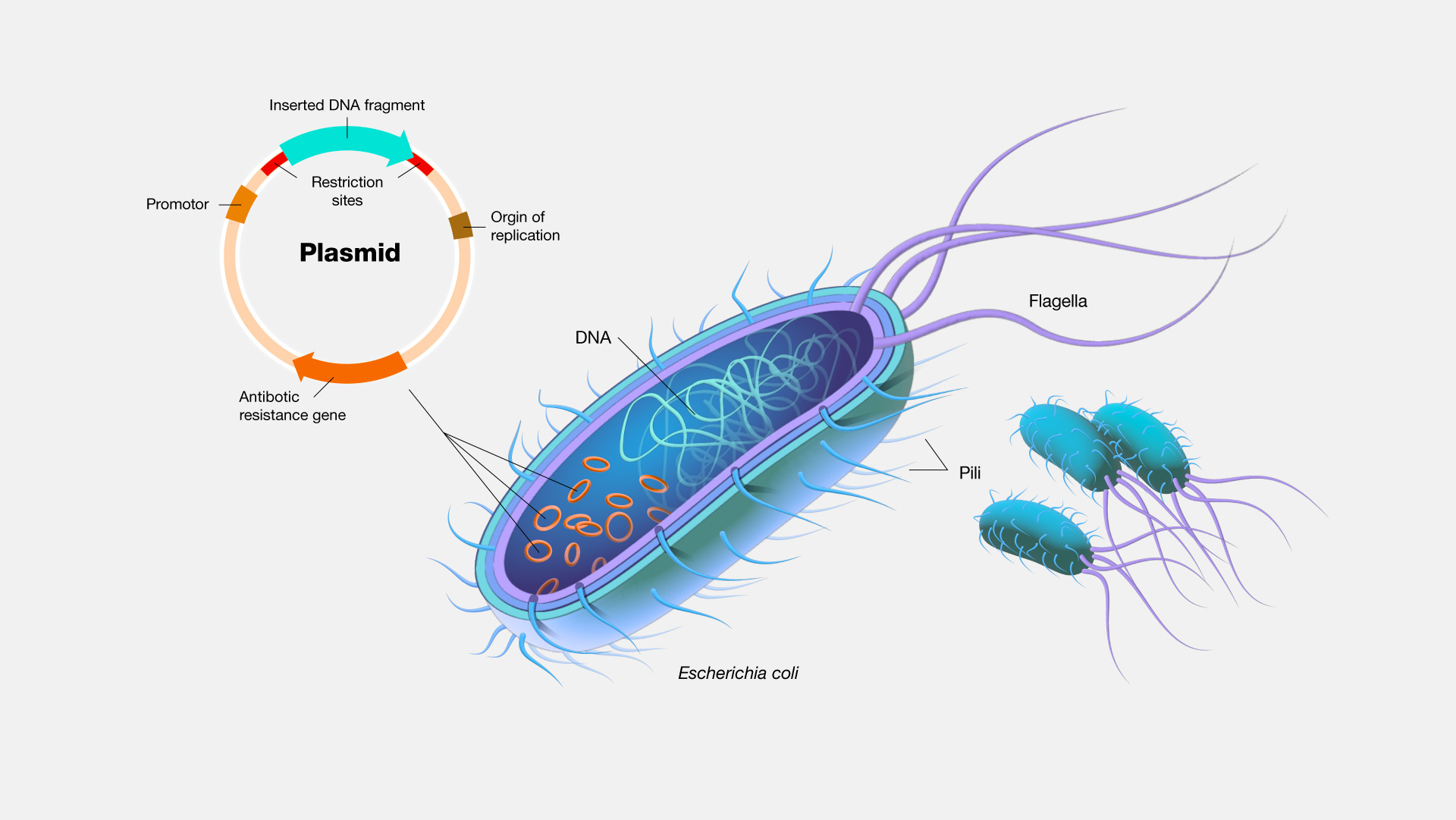
Natural plasmids can carry genes that influence bacterial adaptation, metabolism, virulence or antimicrobial resistance. Engineered plasmid vectors are redesigned to carry a selected DNA sequence and the regulatory elements needed for a specific research workflow.
What are the principal components of a plasmid?
The exact plasmid map depends on its intended host and application. Nevertheless, many cloning and expression plasmids share a set of recognizable functional regions.
Origin of replication
Determines whether the plasmid can replicate in a particular host and contributes to plasmid copy-number behavior.
Selectable marker
Enables researchers to identify or maintain cells carrying the plasmid, commonly through selection under defined culture conditions.
Gene of interest
The experimental sequence inserted for cloning, expression, reporter analysis or another defined molecular biology purpose.
Promoter
Regulates transcription of the inserted sequence and must be compatible with the intended expression system.
Cloning region
Provides restriction sites or assembly-compatible sequences for introducing the selected DNA insert.
Termination signal
Supports controlled termination of transcription and, in some systems, appropriate RNA processing.
What is the function of a plasmid?
Natural plasmid function
In bacteria, plasmids may provide traits that are advantageous under particular environmental conditions. Some plasmids also participate in horizontal gene transfer, allowing genetic information to move between bacterial cells.
Engineered plasmid function
In research, the principal plasmid function is to act as a controllable carrier of genetic information. A plasmid can amplify a DNA insert in bacteria, direct expression of an encoded product, generate a reporter signal or deliver a defined experimental construct into cells.
- Amplification of cloned DNA sequences
- Recombinant protein expression
- Reporter-gene analysis
- Transient or stable transfection workflows
- Delivery of genome-editing components
- Preparation of in vitro transcription templates
- Generation of assay controls
- Study of promoters and regulatory elements
What is plasmid DNA used for?
Plasmid DNA is used as a vector, template or control in molecular biology. The final application depends on the plasmid sequence, host compatibility, copy number, DNA concentration, topology and purity.
Molecular cloning
DNA fragments can be inserted into a plasmid, amplified in bacteria and verified by digestion, PCR or sequencing.
Gene expression
Expression plasmids combine the inserted sequence with regulatory elements suitable for bacterial or eukaryotic systems.
Cell transfection
Purified plasmid DNA can be introduced into cultured cells using lipid-based reagents, polymers, electroporation or related methods.
Reporter assays
Fluorescent, luminescent or enzymatic reporters support analysis of promoter activity, localization and pathway responses.
Genome-editing research
Plasmids can carry nuclease, guide RNA, donor-template or selection components, depending on the experimental strategy.
In vitro transcription
A verified plasmid containing an appropriate promoter can serve as a template for controlled RNA synthesis.
How does plasmid DNA purification work?
Following bacterial culture, plasmid DNA must be separated from genomic DNA, RNA, proteins, lipids, salts and other cellular material. Many column-based plasmid extraction kits combine SDS-alkaline lysis with selective binding of DNA to a silica membrane.
Resuspend the bacterial pellet
Cells are resuspended uniformly. RNase is commonly included to reduce RNA contamination after lysis.
Perform SDS-alkaline lysis
Sodium dodecyl sulfate and sodium hydroxide disrupt cells and denature proteins and nucleic acids.
Neutralize the lysate
Neutralization promotes precipitation of cellular debris and much of the chromosomal DNA while plasmid DNA remains in the clarified fraction.
Clarify by centrifugation
The precipitated bacterial material is separated from the plasmid-containing supernatant.
Bind plasmid DNA to silica
Under defined salt and pH conditions, plasmid DNA is retained by the silica membrane while many contaminants pass through.
Wash and elute
Wash buffers remove residual impurities, after which purified plasmid DNA is recovered using a low-salt elution solution.
Plasmid Mini Kit versus EndoFree Plasmid Maxi Kit
The correct purification scale depends on the bacterial culture volume, required DNA quantity, number of samples and sensitivity of the downstream application.
| Feature | AffiPURE® Plasmid Mini Kit | AffiPURE® EndoFree Plasmid Maxi Kit |
|---|---|---|
| Catalogue number | AFG-M-0075 | AFG-M-0076 |
| Pack format | 100 reactions | 10 reactions |
| Recommended culture scale | 1-5 mL overnight bacterial culture | 150-300 mL overnight bacterial culture |
| Manufacturer-listed capacity or yield | Up to 35 µg binding capacity per column | Approximately 0.2-1.5 mg for high-copy plasmid DNA |
| Purification principle | SDS-alkaline lysis and silica-column purification | SDS-alkaline lysis, endotoxin-scavenging step and silica-column purification |
| Typical use | Clone screening, digestion, PCR, sequencing, ligation and routine preparation | Large-scale preparation, transfection-oriented workflows and in vitro transcription |
AffiPURE® Plasmid Mini Kit
REF: AFG-M-0075- 100-reaction format
- For 1-5 mL overnight bacterial cultures
- Manufacturer-listed binding capacity up to 35 µg per column
- Silica-column workflow without phenol-chloroform extraction
AffiPURE® EndoFree Plasmid Maxi Kit
REF: AFG-M-0076- 10-reaction format
- For 150-300 mL overnight bacterial cultures
- Manufacturer-listed recovery of approximately 0.2-1.5 mg for high-copy plasmids
- Includes an endotoxin-scavenging step before silica purification
How should purified plasmid DNA be evaluated?
A plasmid preparation should be assessed according to the needs of the downstream application. Concentration alone does not establish identity, integrity or functional suitability.
- Concentration: UV absorbance or a DNA-selective fluorescence assay
- Purity: absorbance ratios as an initial contamination indicator
- Integrity: agarose-gel analysis of plasmid forms
- Identity: restriction digestion, PCR or sequencing
- Topology: evaluation of supercoiled, open-circular and linear forms
- Functional suitability: performance in the intended assay
Plasmid topology can influence expression following transfection, and bacterial lipopolysaccharide contamination may reduce transfection efficiency in some cell systems. For sensitive cell-based work, purification scale and endotoxin-control requirements should therefore be selected before the bacterial culture is prepared.
Frequently asked questions about plasmids
What is a plasmid?
A plasmid is a DNA molecule that can be replicated separately from the host cell's principal chromosome. Engineered plasmids are widely used as genetic vectors in molecular biology.
What is plasmid DNA?
Plasmid DNA is the DNA molecule that forms a plasmid. Laboratory plasmids are commonly circular and double-stranded and contain elements needed for replication, selection, cloning or gene expression.
What are plasmids used for?
Plasmids are used for DNA cloning, recombinant protein expression, reporter assays, cell transfection, genome-editing research, assay-control preparation and in vitro transcription.
What is the main function of a plasmid?
In research, the main plasmid function is to carry a defined genetic construct so it can be amplified, analyzed or expressed in a compatible host system.
How is plasmid DNA purified from bacteria?
A common workflow uses SDS-alkaline lysis, neutralization and centrifugation, followed by selective binding of plasmid DNA to a silica membrane, washing and low-salt elution.
What is the difference between a plasmid Mini Kit and a Maxi Kit?
A Mini Kit processes small bacterial cultures and is suited to routine microgram-scale preparations. A Maxi Kit processes much larger cultures and is used when substantially more plasmid DNA is required.
Why is endotoxin-controlled plasmid DNA important?
Endotoxins are bacterial lipopolysaccharides that can affect sensitive cultured cells and may reduce transfection efficiency in some systems. Endotoxin-controlled purification is therefore often selected for demanding cell-based applications.
Which AffiPURE® plasmid purification kit should I choose?
Select the AffiPURE® Plasmid Mini Kit for routine preparation from 1-5 mL cultures. Select the AffiPURE® EndoFree Plasmid Maxi Kit for 150-300 mL cultures, larger DNA requirements or workflows requiring an endotoxin-scavenging step.
AffiGEN product information and PubMed references
- AffiGEN. Plasmids collection .
- AffiGEN. AffiPURE® Plasmid Mini Kit, AFG-M-0075 .
- AffiGEN. AffiPURE® EndoFree Plasmid Maxi Kit, AFG-M-0076 .
- Birnboim HC, Doly J. A rapid alkaline extraction procedure for screening recombinant plasmid DNA. PubMed PMID: 388356 .
- Boom R, et al. Rapid and simple method for purification of nucleic acids. PubMed PMID: 1691208 .
- Figueroa-Bossi N, Bossi L. Preparing Plasmid DNA from Bacteria. PubMed PMID: 35960622 .
- Weber M, et al. Effects of lipopolysaccharide on transfection efficiency. PubMed PMID: 8747659 .
- Weintraub H, Cheng PF, Conrad K. Expression of transfected DNA depends on DNA topology. PubMed PMID: 3459589 .
- Cupillard L, et al. Influence of plasmid DNA topology on transfection. PubMed PMID: 17010468 .
- Smillie C, et al. Mobility of plasmids. PubMed PMID: 20805406 .
Choose the plasmid DNA purification scale that fits your workflow
Explore AffiGEN's Plasmid Mini and EndoFree Plasmid Maxi formats for routine molecular biology, large-scale DNA preparation and transfection-oriented research workflows.
For research use only. Product specifications and availability may change. Verify the current product page and instructions before use.