

CRISPR Gene Editing
CRISPR Gene Editing: How CRISPR-Cas9 Works, Applications & Future
A comprehensive scientific guide to CRISPR gene editing, CRISPR-Cas9 mechanisms, genome engineering, biomedical applications, therapeutic developments, limitations and emerging genome-editing technologies.
What Is CRISPR Gene Editing?
CRISPR gene editing is a genome-engineering technology that allows researchers to make targeted changes to genetic material. In the widely used CRISPR-Cas9 system, a guide RNA directs the Cas9 nuclease toward a selected DNA sequence. Cas9 can then introduce a targeted DNA break, after which cellular DNA-repair mechanisms determine the resulting genetic modification.
What Is CRISPR?
CRISPR originally refers to characteristic repetitive DNA sequences present in bacterial and archaeal genomes. These sequences form part of biological systems that can recognize genetic material associated with previous microbial encounters.
CRISPR-associated proteins, commonly referred to as Cas proteins, can interact with RNA molecules to recognize specific nucleic-acid sequences.
Scientists adapted this biological mechanism to create programmable genome-engineering technologies. Among these, CRISPR-Cas9 gene editing became one of the most widely used approaches.
CRISPR should therefore not be interpreted as a single protein. It describes a broader family of biological systems and genome-engineering tools involving Cas9, Cas12 and other CRISPR-associated proteins.
How Does CRISPR Gene Editing Work?
CRISPR gene editing works by directing a programmable CRISPR-associated protein toward a selected genetic sequence.
In conventional CRISPR-Cas9 gene editing, the mechanism can be divided into four main stages.
Target Selection
A defined genomic region is selected according to the biological objective of the experiment.
Guide RNA Recognition
A guide RNA provides sequence specificity by recognizing a complementary DNA target.
Cas9 Cleavage
The RNA-guided Cas9 nuclease can create a targeted double-strand break in DNA.
Cellular Repair
Endogenous DNA-repair pathways process the break and determine the resulting genomic modification.
CRISPR Gene Editing Diagram
The following simplified CRISPR gene editing diagram illustrates the basic conceptual workflow of CRISPR-Cas9-mediated genome editing.
A specific genomic sequence is selected.
Guide RNA directs the CRISPR-Cas9 complex toward complementary DNA.
Cas9 recognizes the appropriate genomic region together with the required neighboring PAM sequence.
Cas9 can generate a targeted DNA double-strand break.
Endogenous DNA-repair pathways process the damaged DNA.
The final result may include gene disruption or another targeted sequence modification depending on the editing strategy.
What Are the Main Components of CRISPR-Cas9?
Guide RNA
The guide RNA (gRNA) provides sequence specificity. Part of the guide RNA can base-pair with a complementary genomic DNA sequence and direct Cas9 toward the intended target.

Cas9 Nuclease
Cas9 is an RNA-guided DNA endonuclease. Following appropriate target recognition, Cas9 can cleave both strands of DNA near the targeted sequence.

PAM Sequence
Cas9 target recognition also requires an adjacent sequence known as a protospacer adjacent motif (PAM).
PAM requirements differ between CRISPR-associated proteins. This affects which genomic sequences can potentially be targeted by a particular CRISPR system.
What Happens After CRISPR-Cas9 Cuts DNA?
Non-Homologous End Joining :
Non-homologous end joining (NHEJ) reconnects DNA ends and can generate small insertions or deletions.
These modifications can disrupt a coding sequence and are therefore commonly associated with gene-knockout strategies.

Homology-Directed Repair :
Homology-directed repair (HDR) uses homologous DNA information during repair and can, in suitable experimental conditions, support defined sequence modifications.
DNA-repair pathway activity varies according to biological factors including cell type and cell-cycle state.

What Is CRISPR Gene Editing Used For?
CRISPR technology is used extensively across molecular biology, biomedical research, functional genomics and biotechnology.
Functional Genomics
Researchers can disrupt or regulate genes to examine their functions and associated cellular phenotypes.
Disease Modeling
Disease-associated genetic variants can be introduced into experimental models to study molecular mechanisms.
Cancer Research
CRISPR supports research into oncogenes, tumor suppressors, drug resistance and cancer-cell dependencies.
Stem Cell Research
Genome editing enables investigation of gene function during stem-cell differentiation and development.
Therapeutic Research
Genome-editing strategies are being developed for selected inherited disorders and other genetically defined diseases.
Biotechnology
CRISPR is applied in biotechnology, genetic screening, engineered cell systems and agricultural research.
CRISPR-Cas9 vs Base Editing vs Prime Editing
Modern genome engineering includes several related technologies that produce genetic modifications through different molecular mechanisms.
| Technology | Main Principle | Programmed Double-Strand Break | Typical Capability |
|---|---|---|---|
| CRISPR-Cas9 | RNA-guided DNA cleavage | Typically yes | Gene disruption and targeted genome modification |
| Base Editing | Targeted chemical modification of DNA bases | Generally no conventional double-strand break | Selected nucleotide substitutions |
| Prime Editing | CRISPR targeting combined with reverse-transcription-based DNA rewriting | Generally no conventional double-strand break | Selected substitutions, small insertions and deletions |
These genome-editing technologies are complementary rather than interchangeable. The optimal approach depends on the required genetic change, biological system and experimental objective.
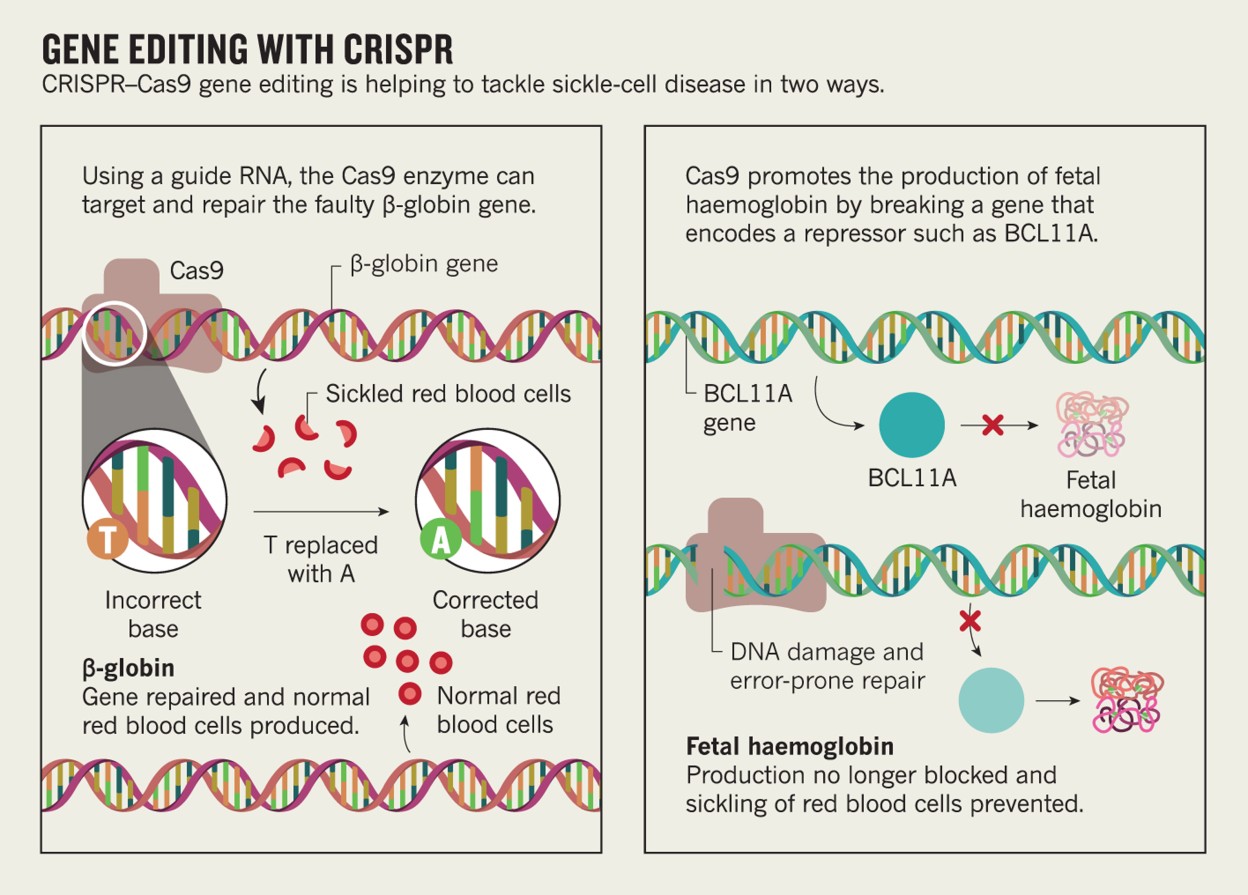
CRISPR Gene Editing and Sickle Cell Disease
Sickle cell disease is one of the most important examples of the translation of CRISPR gene editing from experimental research toward clinical medicine.
Sickle cell disease results from pathogenic variation affecting beta-globin and can lead to abnormal hemoglobin polymerization, red-blood-cell deformation, hemolysis and vaso-occlusive complications.
One genome-editing strategy modifies a regulatory region in a patient's hematopoietic stem and progenitor cells to increase production of fetal hemoglobin (HbF).
Increased fetal hemoglobin can reduce the pathological consequences associated with sickle hemoglobin.
Ex Vivo vs In Vivo CRISPR Gene Editing
| Approach | Where Editing Occurs | General Concept |
|---|---|---|
| Ex Vivo | Outside the body | Cells are collected, genetically modified and subsequently administered to the patient. |
| In Vivo | Inside the body | Genome-editing components are delivered directly to target cells or tissues. |
Ex vivo editing enables characterization of modified cells before administration. In vivo editing can potentially target tissues that cannot easily be removed and manipulated outside the body.
What Are the Advantages of CRISPR Gene Editing?
CRISPR became widely adopted because RNA-guided targeting provides considerable flexibility for genome engineering.
- Programmable targeting of defined genomic regions.
- Application across many experimental organisms and cell systems.
- Compatibility with multiplex genetic studies.
- Support for large-scale functional genomic screening.
- Adaptability to gene activation and repression.
- Development of base-editing and prime-editing technologies.
- Potential applications in therapeutic genome engineering.
What Are the Limitations of CRISPR Gene Editing?
CRISPR gene editing is powerful, but genome editing is not inherently error-free.
Off-Target Editing
=> CRISPR-associated nucleases may potentially interact with genomic sequences that resemble the intended target. Unintended modification at such locations is referred to as off-target editing.
Unintended On-Target Outcomes
=> Even at the intended target, DNA repair can sometimes produce heterogeneous or unexpected sequence outcomes.
Delivery
=> Efficient delivery of genome-editing components to the appropriate tissue or cell population remains a major challenge for many therapeutic applications.
Cell-Type Dependence
=> Genome-editing efficiency and DNA-repair outcomes can differ substantially between cell types and biological states.
Safety Considerations
=> Therapeutic genome-editing strategies require rigorous evaluation of genomic integrity, unintended effects, immune responses and long-term safety.
CRISPR-Cas9 vs Earlier Gene-Editing Technologies
CRISPR is not the first technology developed for targeted genome engineering. Earlier platforms include zinc-finger nucleases (ZFNs) and transcription activator-like effector nucleases (TALENs) .
An important difference is that CRISPR systems generally use RNA sequences for target recognition, while ZFN and TALEN systems depend more heavily on engineered DNA-binding proteins.
This RNA-programmable architecture contributed to the widespread adoption of CRISPR for functional genomics and multiplex genome-engineering research.
What Are the Ethical Issues of CRISPR Gene Editing?
Somatic Genome Editing
Somatic genome editing modifies non-reproductive cells. Such changes are generally intended to affect the treated individual rather than future generations.
Germline Genome Editing
Editing genetic material in eggs, sperm or embryos could potentially generate genetic changes that are inherited by subsequent generations.
Heritable human genome editing therefore raises different scientific, ethical, regulatory and social considerations from somatic therapeutic genome editing.
Important issues include safety, informed consent, equitable access, unintended genetic consequences and the distinction between disease treatment and non-medical genetic enhancement.
What Is the Future of CRISPR Gene Editing?
More Precise Genome Editing
=> High-fidelity nucleases, base editors and prime editors are expanding the range of genetic changes that can potentially be introduced.
Improved In Vivo Delivery
=> Improved delivery technologies may allow genome editors to reach a broader range of tissues while improving cell-type specificity.
Expanded Therapeutic Applications
=> CRISPR-based therapeutics are being investigated for inherited diseases, hematological disorders, cancer and other conditions with genetically defined mechanisms.
Personalized Genome Editing
=> Future genome-editing strategies may increasingly target rare or patient-specific pathogenic genetic variants.
CRISPR Beyond DNA Cutting
=> CRISPR-associated technologies can also be adapted for transcriptional regulation, epigenome modification, RNA targeting, diagnostics and other applications beyond conventional DNA cleavage.
CRISPR Gene Editing Summary
| What does CRISPR mean? | Clustered Regularly Interspaced Short Palindromic Repeats. |
|---|---|
| What is CRISPR gene editing? | A programmable approach for introducing targeted changes into genetic material. |
| What is CRISPR-Cas9? | A genome-editing system combining RNA-guided targeting with the Cas9 nuclease. |
| What guides Cas9? | Guide RNA. |
| What does Cas9 do? | Cas9 can introduce targeted DNA cleavage. |
| What happens after DNA cleavage? | Cellular DNA-repair pathways process the DNA and determine the resulting genetic outcome. |
| Main CRISPR challenges | Specificity, delivery, efficiency, unintended outcomes and long-term safety. |
Frequently Asked Questions About CRISPR Gene Editing
What is CRISPR gene editing?
CRISPR gene editing is a genome-engineering approach using programmable RNA-guided systems to target specific genetic sequences.
How does CRISPR gene editing work?
In conventional CRISPR-Cas9 editing, a guide RNA directs Cas9 toward a complementary DNA sequence. Cas9 can then cleave the DNA, and cellular DNA-repair pathways determine the resulting genetic modification.
What is CRISPR-Cas9?
CRISPR-Cas9 is an RNA-guided genome-editing system in which the Cas9 nuclease can be directed toward selected DNA sequences.
What is the difference between CRISPR and Cas9?
CRISPR describes the broader biological system and genome-engineering platform. Cas9 is one specific CRISPR-associated nuclease used for targeted DNA cleavage.
What are CRISPR off-target effects?
Off-target effects are unintended genomic modifications occurring at locations other than the intended CRISPR target.
Is CRISPR used for sickle cell disease?
CRISPR-Cas9-based ex vivo genome editing has reached clinical application for selected inherited blood disorders including sickle cell disease.
Is CRISPR the same as genetic engineering?
No. Genetic engineering is the broader field involving deliberate modification of genetic material. CRISPR represents one family of technologies used for genome engineering.
What is the future of CRISPR gene editing?
Future CRISPR technologies are expected to focus on higher precision, improved delivery, expanded in vivo applications, safer therapeutic editing and advanced technologies such as base and prime editing.
Understanding CRISPR Gene Editing
CRISPR gene editing has transformed genome engineering by providing researchers with programmable tools for targeting defined genetic sequences.
The classical CRISPR-Cas9 system combines guide-RNA-based target recognition with Cas9-mediated DNA cleavage, while technologies such as base editing and prime editing expand the range of possible genetic modifications.
CRISPR technology is widely used in functional genomics, disease modeling, cancer biology, stem-cell research, biotechnology and therapeutic development.
Nevertheless, successful genome editing requires careful evaluation of specificity, genomic integrity, delivery, cellular context, potential unintended effects and safety.
As genome-engineering technologies continue to evolve, the future of CRISPR is likely to involve increasingly precise, controllable and disease-specific approaches to understanding and modifying genetic information.