

Total Polyamine Fluorometric Assay Kit for Polyamine Metabolism Research
Total Polyamine Fluorometric Assay Kit for Polyamine Metabolism Research
Measure total polyamine levels in cell lysates, tissue extracts, and clarified biological preparations using a fluorescence-based 96-well assay designed for modern life science research.
View ProductWhat Is Polyamine?
A polyamine is a small organic molecule containing multiple amine groups. In biological systems, the most studied polyamines include putrescine, spermidine, and spermine. Because these molecules are positively charged, they can interact with DNA, RNA, proteins, and cellular membranes.

This makes polyamines important in molecular biology, cell growth, gene regulation, metabolism, cellular stress response, mitochondrial activity, and cancer biology research.
Why Total Polyamine Measurement Matters?
Polyamine levels are tightly regulated by biosynthesis, degradation, transport, and cellular uptake. When this balance changes, the total polyamine pool may also shift. This makes total polyamine quantification useful for studying how cells respond to treatment, stress, metabolic changes, or altered pathway activity.
Research value
- Compare treated and untreated samples
- Study changes in cell growth and viability
- Support polyamine pathway analysis
- Evaluate metabolic and mitochondrial responses
Scientific relevance
- Polyamine metabolism research
- Cancer biology models
- Inflammation and oxidative stress studies
- Neurobiology and cell physiology research
Polyamine Chemistry and Biological Function
From a chemical perspective, polyamines are rich in amino groups and carry positive charges under physiological conditions. This gives them the ability to associate with negatively charged biological structures, especially nucleic acids and phospholipids.
| Polyamine | Research importance | Common study context |
|---|---|---|
|
Putrescine |
Early intermediate in polyamine biosynthesis | Cell growth and metabolic pathway research |
| Spermidine | Associated with cellular regulation and stress-response studies | Aging, autophagy-related models, and metabolism research |
| Spermine | Involved in nucleic acid interaction and cellular regulation | Cell physiology, proliferation, and cancer research models |
Polyamine Metabolism and the Polyamine Pathway
The polyamine pathway includes synthesis, interconversion, catabolism, uptake, and export. Because polyamines support cellular growth and adaptation, the pathway is often investigated in experimental models involving proliferation, differentiation, inflammation, oxidative stress, and metabolic regulation.
A total polyamine assay does not separate putrescine, spermidine, and spermine individually. Instead, it provides a practical readout of the combined polyamine content in the sample. This is useful when researchers need a global measurement of polyamine status before moving to more targeted analysis.
Polyamines and Cancer Research
Polyamines are frequently studied in cancer biology because actively proliferating cells often show increased demand for growth-associated metabolic pathways. Researchers use polyamine measurement to investigate how experimental conditions affect proliferation, cellular stress, metabolic adaptation, and pathway regulation.
About the AffiASSAY® Total Polyamine Fluorometric Assay Kit
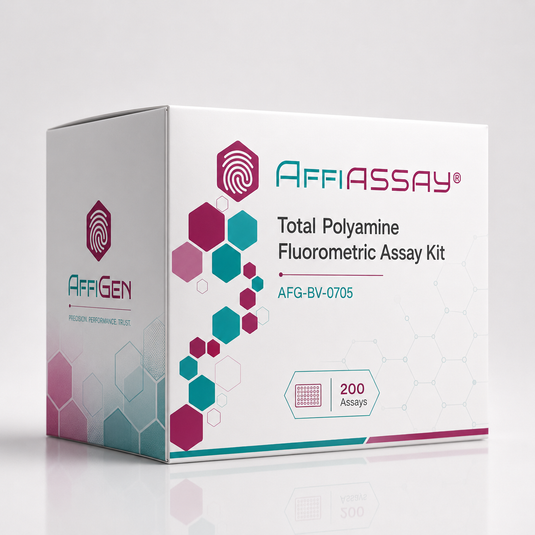
The AffiASSAY® Total Polyamine Fluorometric Assay Kit is a 96-well research assay developed for fluorescence-based measurement of total polyamine content in compatible biological samples. The assay generates a fluorescent signal proportional to the amount of polyamine present in the sample.
| Product name | AffiASSAY® Total Polyamine Fluorometric Assay Kit |
|---|---|
| Catalog number | AFG-BV-0705 |
| Format | 96-well microplate workflow |
| Detection method | Fluorometric |
| Recommended fluorescence | Excitation around 535 nm / emission around 587 nm |
| Compatible samples | Cell lysates, tissue extracts, and clarified biological preparations |
| Product variant | 100 Assays |
| Intended use | Research use only |
How the Fluorometric Polyamine Assay Works?
The assay uses an enzymatic conversion system to transform polyamine-containing samples into a fluorescent reaction product. The fluorescence signal increases in proportion to the total polyamine content of the sample.
- Prepare standards, blanks, controls, and clarified samples.
- Add standards and samples to a suitable 96-well fluorescence microplate.
- Add the working reaction mixture according to the assay workflow.
- Measure fluorescence using compatible microplate reader settings.
- Calculate total polyamine content from the corrected calibration curve.

Applications in Life Science Research
The AffiASSAY® Total Polyamine Fluorometric Assay Kit is suitable for laboratories working in cell biology, biochemistry, cancer research, neurobiology, metabolic research, and molecular biology.
Common applications
- Total polyamine quantification
- Polyamine metabolism studies
- Polyamine pathway research
- Cell growth and proliferation experiments
- Comparison of treated and untreated samples
Research fields
- Cancer biology research
- Inflammation and oxidative stress models
- Mitochondrial function studies
- Neurobiology research
- Metabolic regulation studies
Sample Preparation Guidance
For reliable fluorescence measurement, samples should be clarified before use. Insoluble material, strong autofluorescent contaminants, and incompatible buffers may interfere with the signal. Researchers should use matched blanks and background-control wells when sample matrix effects are expected.
| Sample type | Preparation recommendation | Why it matters |
|---|---|---|
| Cell lysates | Prepare clarified lysate and keep samples cold during preparation | Reduces degradation and debris-related optical interference |
| Tissue extracts | Homogenize on ice, centrifuge, and collect clear supernatant | Improves reproducibility and plate-reading consistency |
| Biological preparations | Evaluate dilution and background correction | Helps control matrix-specific fluorescence background |
For Research Laboratories Worldwide
Polyamine research is active across molecular biology, cell biology, metabolic research, and oncology-focused laboratories. The AffiASSAY® Total Polyamine Fluorometric Assay Kit supports research workflows for laboratories in the United States, Germany, France, Canada, India, Taiwan, and other international research markets.
With a microplate-based format, the kit is suitable for laboratories that need parallel sample comparison, consistent fluorescence readout, and a practical workflow for total polyamine measurement.
Frequently Asked Questions
What does a total polyamine assay measure?
A total polyamine assay measures the combined polyamine content in a compatible research sample. It does not individually separate putrescine, spermidine, and spermine.
What are polyamines used for in research?
Polyamines are studied in cell growth, metabolism, gene regulation, mitochondrial function, oxidative stress, inflammation, aging-related models, and cancer biology research.
Is this kit a polyamine supplement?
No. The AffiASSAY® Total Polyamine Fluorometric Assay Kit is a laboratory assay kit. It is not a supplement, drug, food ingredient, diagnostic product, or therapeutic product.
Can this assay be used for cancer diagnosis?
No. The kit is intended for research use only. It can support cancer biology research models, but it is not intended for diagnosis, treatment decisions, or clinical testing.
Which samples are compatible with the kit?
The kit is designed for compatible clarified biological preparations, including cell lysates and tissue extracts. Samples should be free of insoluble debris before fluorescence measurement.
Which fluorescence settings are recommended?
Recommended detection is excitation around 535 nm and emission around 587 nm. Settings may be adjusted depending on the microplate reader, plate type, and laboratory workflow.
Conclusion
Polyamines are important molecules in cell growth, metabolism, stress response, and cancer biology research. Measuring total polyamine content gives researchers a practical way to compare biological changes across experimental conditions.
The AffiASSAY® Total Polyamine Fluorometric Assay Kit provides a fluorescence-based 96-well workflow for total polyamine quantification in compatible biological research samples.
Explore the AffiASSAY® Total Polyamine Fluorometric Assay Kit
Designed for research laboratories studying polyamine metabolism, polyamine chemistry, cell growth, metabolic regulation, and cancer biology models.
View Product Details