
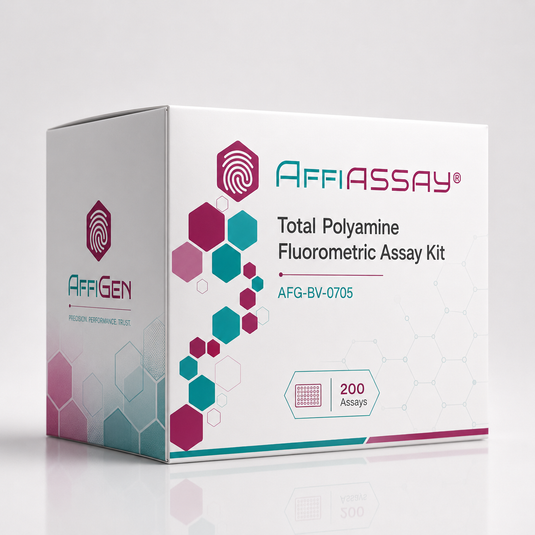
AffiASSAY® Total Polyamine Assay Kit - Fluorometric
Total Polyamine Fluorometric Assay Kit is a 96-well research assay for measuring total polyamine content in compatible biological samples. The kit supports fluorescence-based polyamine quantification in cell lysates, tissue extracts, and clarified biological preparations.
This total polyamine assay is suitable for studies involving cell growth, differentiation, cellular stress response, mitochondrial activity, metabolism, inflammation, neurobiology, and cancer research.
What Are Polyamines?
Polyamines are small positively charged molecules that include putrescine, spermidine, and spermine. They are widely studied because they are associated with cell proliferation, apoptosis, gene regulation, angiogenesis, metabolic regulation, mitochondrial function, and cellular adaptation to stress.
Changes in polyamine metabolism are commonly investigated in cancer biology, inflammatory response, neuroscience, aging research, metabolic studies, and cell physiology. A total polyamine assay provides a practical way to compare polyamine levels between experimental groups.
Assay Principle
The assay uses an enzymatic conversion system that transforms polyamine-containing samples into a fluorescent reaction product. The generated fluorescence signal increases in proportion to the amount of polyamine present in the sample.
Fluorescence may be measured in kinetic or endpoint mode depending on the sample type, plate reader configuration, incubation time, and laboratory workflow.
Applications
- Total polyamine quantification in biological research samples
- Comparison of polyamine levels between treated and untreated samples
- Cell growth, viability, and proliferation studies
- Cancer biology and metabolic pathway research
- Inflammation, oxidative stress, and cellular stress response studies
- Neurobiology and mitochondrial function research
Kit Components and Functional Roles
The kit is organized with functional component names to support clear laboratory use while keeping the workflow simple and practical.
| Component | Format | Function |
|---|---|---|
| Assay Diluent | Liquid | Used for sample preparation, dilution, and reaction volume adjustment. |
| Fluorescent Detection Reagent | Concentrated liquid | Supports generation of the fluorescent signal after enzymatic conversion. |
| Conversion Enzyme Mix | Lyophilized | Supports conversion of polyamine-related analytes into a detectable reaction product. |
| Signal Development Enzyme | Lyophilized | Enhances fluorescence signal development during the assay reaction. |
| Polyamine Calibrator | Lyophilized | Used to prepare a calibration curve for sample quantification. |
Sample Compatibility
The assay is intended for compatible clarified biological samples. Samples should be free of insoluble material before measurement to reduce optical interference and improve reproducibility.
| Sample Type | General Preparation Guidance |
|---|---|
| Cell pellets | Prepare a clarified lysate using an assay-compatible buffer. Keep samples cold during preparation. |
| Tissue samples | Homogenize on ice, centrifuge to remove debris, and use the clear supernatant for analysis. |
| Other biological extracts | Evaluate dilution and background correction depending on matrix composition. |
General Assay Workflow
- Prepare the fluorescence microplate reader and equilibrate the assay temperature to 37°C.
- Prepare a calibration curve using the supplied polyamine calibrator and assay-compatible diluent.
- Add standards and prepared samples to a suitable black or white 96-well microplate.
- Adjust all wells to a uniform pre-reaction volume using assay diluent.
- Prepare the working reaction mixture immediately before use.
- Add the working reaction mixture consistently to standards, samples, and relevant controls.
- Include matched background-control wells when sample matrix correction is required.
- Measure fluorescence kinetically or after sufficient signal development.
- Calculate total polyamine levels using the background-corrected calibration curve.
Suggested Plate Setup
| Well Type | Recommended Setup | Purpose |
|---|---|---|
| Blank | Assay diluent plus detection mixture | Establishes baseline fluorescence. |
| Standards | Serially prepared polyamine calibrator levels | Generates the reference curve for quantification. |
| Samples | Prepared sample extract plus reaction mixture | Measures total polyamine content in research samples. |
| Background Controls | Matched sample wells without the full conversion system | Corrects sample-specific background signal when required. |
Optimized Working Volumes
| Step | Suggested Volume per Well | Comment |
|---|---|---|
| Standard or sample input | 20-40 µL | Adjust depending on expected polyamine level and sample availability. |
| Assay diluent adjustment | Bring to 50 µL | Maintain the same pre-reaction volume across all wells. |
| Working reaction mixture | 50 µL | Add consistently to standards, samples, and appropriate controls. |
| Final reaction volume | 100 µL | Recommended for standard 96-well fluorescence reading. |
Measurement and Data Analysis
Fluorescence may be monitored at 37°C using kinetic readings over approximately 20-30 minutes. Signal development typically increases with total polyamine amount and may reach a stable phase depending on sample concentration and reaction conditions.
For best results, read standards and samples in duplicate. If sample background is expected, include paired background-control wells and subtract the corresponding background value before calculating sample concentration.
Calculation Guidance
Subtract the blank or zero-standard value from all standards to generate a corrected calibration curve. Subtract matched background-control values from samples when applicable. Determine sample polyamine amount by comparing corrected fluorescence signals to the calibration curve.
Final results may be expressed as polyamine amount per sample volume, per mg tissue, per mg protein, or per number of cells depending on the chosen sample normalization method.
Representative Assay Performance
The curves below illustrate typical assay behavior using representative data. Actual signal intensity may vary depending on the microplate reader, plate type, incubation time, sample matrix, and laboratory conditions.
Representative Standard Curve
Representative standard curve showing a linear increase in fluorescence signal across the tested polyamine standard range.
Representative Kinetic Signal Development
Representative kinetic profile showing progressive fluorescence development over time. Higher polyamine levels produce stronger fluorescence responses.
Representative Results
The following values are provided as an example of expected assay behavior. Actual readings may vary depending on the instrument, plate type, incubation time, and sample matrix.
| Polyamine Standard | Representative Raw Signal | Background-Corrected Signal |
|---|---|---|
| 0 pmol | 268 | 0 |
| 50 pmol | 724 | 456 |
| 100 pmol | 1188 | 920 |
| 150 pmol | 1652 | 1384 |
| 200 pmol | 2115 | 1847 |
| 250 pmol | 2576 | 2308 |
Storage and Handling
- Store unopened kit components at -20°C unless otherwise indicated on the product label.
- Bring components to room temperature before use.
- Briefly centrifuge vials before opening to collect material at the bottom of each tube.
- Protect light-sensitive components from direct light during preparation and use.
- Keep prepared enzyme-containing solutions on ice while in use.
- Avoid repeated freeze-thaw cycles by preparing convenient working aliquots when appropriate.
Product Information
| Product Name | AffiASSAY® Total Polyamine Assay Kit - Fluorometric |
|---|---|
| Catalog Number | AFG-BV-0705 |
| Detection Method | Fluorometric |
| Format | 96-well microplate assay |
| Size | 200 assays |
| Application | Measurement of total polyamine levels in research samples |
Frequently Asked Questions
What does the Total Polyamine Fluorometric Assay Kit measure?
The kit is designed to measure total polyamine content in compatible biological research samples. It is useful for studying polyamine metabolism and comparing relative polyamine levels between sample groups.
Which samples can be used with this polyamine assay?
The assay is suitable for compatible clarified biological preparations such as cell lysates, tissue extracts, and other biological extracts. Samples should be cleared by centrifugation before fluorescence measurement.
Which fluorescence settings are recommended?
Recommended detection is excitation around 535 nm and emission around 587 nm. Settings may be adjusted depending on the microplate reader and plate type.
Can the assay be read in kinetic mode?
Yes. Fluorescence can be monitored kinetically or measured after endpoint signal development, depending on the laboratory workflow and sample behavior.
Is this product intended for diagnostic use?
No. This product is for research use only and is not intended for diagnostic or therapeutic use.
Research Use Only: For research use only. Not intended for diagnostic or therapeutic use.