
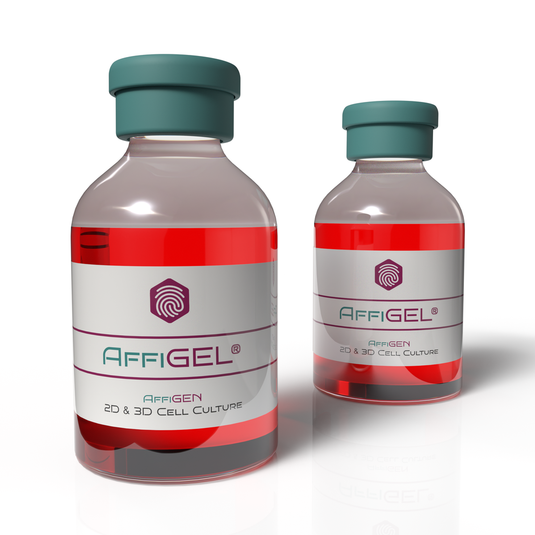
AffiGEL® Matrix GFR, Phenol Red-Free, LDEV-Free
- Equivalent: 356231 | Corning® Matrigel® Growth Factor Reduced (GFR) Basement Membrane Matrix, Phenol Red-free, LDEV-free
- Matrix type: Growth factor reduction
- Application: Mainly to exclude the interference of growth factors on the experiment. Applied to related research on growth factors, signaling pathways, etc.
Product Information
AffiGEL® Matrix GFR, Phenol Red-Free, LDEV-Free is a solubilized basement membrane preparation extracted from the Engelbreth-Holm-Swarm (EHS) mouse sarcoma, a tumor rich in extracellular matrix (ECM) proteins, including Laminin (a major component), Collagen IV, heparan sulfate proteoglycans, entactin/nidogen, and a number of growth factors.
Quality
- Mouse colonies routinely screened for pathogens via Mouse Antibody Production (MAP) testing
- Extensive PCR testing is performed to screen for a number of pathogens
- Tested and found negative for bacteria, fungi, and mycoplasma
- Protein concentrations determined by Lowry method
- Endotoxin units measured by Limulus Amoebocyte Lysate assay
- Matrigel Matrix gel stability is tested for a period of 14 days at 37°C
- Biological activity is determined for each lot using a neurite outgrowth assay
Source
Engelbreth-Holm-Swarm Mouse Tumor
Preparation and Storage
Store at -20°C. Avoid multiple freeze-thaws. Do not store in frost-free freezer. KEEP FROZEN.
Application
- Cell Growth and Differentiation
- Metabolism/Toxicology Studies
- Invasion Assays
- in vitro and in vivo Angiogenesis Assays
- in vivo Angiogenesis Studies and Augmentation of Tumors in Immunosuppressed Mice